
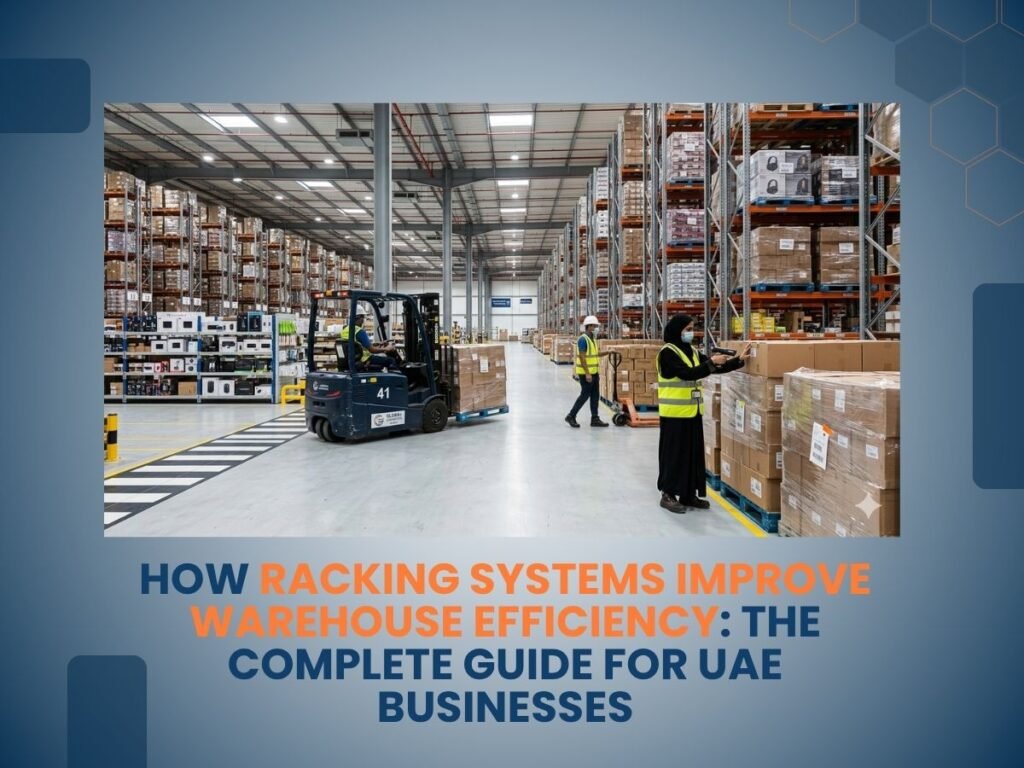
Space is money – and in Dubai’s competitive logistics landscape, every square metre of warehouse floor counts. A well-designed warehouse racking system can transform a disorganised storage facility into a highly productive operation, enabling businesses to store more, pick faster, and reduce errors.
Whether you manage a food distribution centre, a manufacturing parts store, or a retail fulfilment hub, this guide explains how the right racking system can dramatically improve your warehouse efficiency.
What Is a Warehouse Racking System?
A warehouse racking system is a structural storage solution that uses steel frameworks, shelves, and beams to stack inventory vertically, making full use of available building height rather than just floor space.
Unlike simple shelving, industrial racking is engineered to bear heavy loads, allow forklift access, and be configured in multiple layouts depending on your product type, turnover rate, and building dimensions.
In the UAE, where warehousing and logistics are central to supply chains across retail, food and beverage, construction, and e-commerce, efficient racking is a strategic investment – not just a storage convenience.
The Core Benefits of Warehouse Racking Systems
1. Maximising Vertical Storage Space
The most immediate benefit of installing a proper racking system is the recovery of vertical space. Most warehouses use only a fraction of their available height. A well-planned racking layout can increase storage capacity by 40% to 100% without expanding the building footprint.
This is especially valuable in Dubai and the wider UAE, where commercial property and warehouse rental costs are significant. Fitting more inventory into the same space reduces the need for additional facilities.
2. Faster Picking and Reduced Errors
When goods are stored on a racking system with a clear, logical layout, warehouse staff can locate and retrieve products quickly. This directly reduces the time spent per order pick and lowers the error rate.
Organised racking also supports effective labelling and barcode scanning, making it easier to integrate with warehouse management systems (WMS). The result is faster order fulfilment and fewer dispatch mistakes.
3. Improved Inventory Visibility and Stock Rotation
Racking systems make it possible to implement FIFO (First In, First Out) stock rotation – critical for food, pharmaceutical, and any date-sensitive inventory. When goods are stored in accessible rows with clear sight lines, staff can immediately see what is available and ensure older stock moves first.
This reduces waste, minimises the risk of selling expired products, and keeps stock counts accurate.
4. Enhanced Warehouse Safety
A properly installed racking system eliminates the dangerous practice of stacking goods directly on the floor or in unstable piles. Goods on racking are secured in position, reducing the risk of falling stock that could injure workers or damage products.
High-quality steel racking also includes safety features such as end guards, column protectors, safety pins on beams, and load capacity labels – all of which contribute to a safer working environment.
5. Flexibility and Scalability
Modern warehouse racking systems are modular. As your business grows, you can add bays, increase height, or reconfigure the layout without replacing the entire system. This makes racking a long-term investment that adapts to changing business needs.
Types of Warehouse Racking Systems
Different warehouses have different needs. Here is an overview of the most common racking types used in UAE facilities:
Selective Pallet Racking The most widely used type. Each pallet is directly accessible, making it ideal for warehouses with a large variety of SKUs and high stock turnover. It works with standard counterbalance or reach forklifts.
Drive-In / Drive-Through Racking Allows forklifts to enter the racking structure to place or retrieve pallets. Suitable for high-density storage of the same product type where LIFO (Last In, First Out) stock rotation is acceptable.
Narrow-Aisle Racking Reduces aisle width to increase storage density. Requires specialist narrow-aisle forklifts. Excellent for high-bay warehouses where maximising capacity per square metre is the priority.
Cantilever Racking Designed for long, bulky items such as pipes, timber, steel bars, and rolled goods. The open-front design allows easy forklift or crane access to oversized products.
Mobile Racking (Compactus) Mounted on motorised bases that slide along floor tracks, eliminating all fixed aisles except one. Maximises storage density – often used for archives, pharmaceuticals, and high-value goods with lower daily turnover.
Multi-Tier Racking Creates multiple levels of shelving accessible via mezzanine walkways and stairs. Ideal for slower-moving, hand-picked items such as spare parts, e-commerce goods, and small consumer products.
Warehouse Racking and Cold Storage: A Critical Combination
For businesses operating cold rooms or chilled warehouses – including food distributors, pharmaceutical companies, and caterers – racking takes on additional importance.
In a cold storage environment, the layout of racking directly impacts the efficiency of air circulation. Poorly placed racking can create warm spots, reduce airflow around the refrigeration evaporator, and force the cooling system to work harder.
The right racking configuration in a cold room will:
- Allow cold air to circulate freely around all stored products
- Support FIFO rotation so that temperature-sensitive goods with earlier expiry dates are always picked first
- Use materials resistant to corrosion in high-humidity, low-temperature environments (galvanised or stainless steel is preferred)
- Be compatible with pallet wrapping standards that maintain product hygiene
VD Technical supplies and installs warehouse racking systems in Dubai designed to work seamlessly with cold storage environments, including those built around their manufactured cold rooms and refrigerated containers.
How to Choose the Right Racking System for Your Warehouse
Before selecting a racking system, consider these key factors:
- Product type and weight: Heavy pallets need heavy-duty pallet racking. Light consumer goods may suit shelving or multi-tier systems.
- Turnover rate: High-turnover SKUs need accessible selective racking. Slow movers can tolerate drive-in or mobile configurations.
- Forklift type: Your existing materials handling equipment will determine aisle width requirements and racking compatibility.
- Building height: The higher the ceiling, the more vertical storage is possible – but higher racking requires appropriate forklift reach and fire suppression planning.
- Future growth: A modular, expandable system protects your investment as volume grows.
- Regulatory compliance: Racking installations in the UAE must comply with structural safety standards. Always use a supplier who provides load capacity documentation and certified installation.
Maintaining Your Warehouse Racking System
Racking that is damaged – even slightly bent uprights or beams – can fail catastrophically under load. A regular inspection and maintenance programme is essential.
Best practice includes:
- Monthly visual inspections by trained warehouse staff
- Annual professional inspection and load-bearing verification
- Immediate tagging and removal from service of any damaged component
- Replacement of damaged parts with manufacturer-certified components
Never repair racking with improvised materials or continue using visibly damaged sections under load.
Frequently Asked Questions
Q1: How much weight can a warehouse racking system hold?
A: Pallet racking capacity varies by design and manufacturer, typically supporting 1,000–4,000 kg per beam level.
Q2: What is the difference between shelving and racking?
A: Shelving suits light storage; racking handles heavy pallets and industrial warehouse operations.
Q3: How long does it take to install a warehouse racking system?
A: Small racking installations take 1–3 days, while large warehouse systems may require up to two weeks.
Transform Your Warehouse Storage with VD Technical
If your warehouse is running out of space, experiencing picking errors, or simply not operating as efficiently as it should, a professionally designed and installed racking system is the solution.
VD Technical supplies and installs warehouse racking systems across Dubai and the UAE, engineered for durability in the UAE’s climate and configured to your specific operational needs.
Contact VD Technical today for a warehouse assessment and racking quotation. Let their team help you make the most of every square metre.